In our everyday lives, we take for granted that we can know exactly where something is and where it’s going.
If you throw a baseball, you can measure its position and its speed simultaneously with perfect precision (provided your equipment is good enough).
But in early 20th century, German physicist Werner Heisenberg realized that universe plays by a much stranger set of rules at atomic level. His Uncertainty Principle (1927) fundamentally changed our understanding of reality, suggesting that at most basic level, nature is blurry.
Core Concept
The Uncertainty Principle states that it is impossible to measure certain pairs of physical properties—most notably position (χ) and momentum (ρ)—with infinite precision at same time.
More accurately you know where a particle is, less accurately you can know how fast it is moving, and vice versa. This isn’t a limitation of our technology; it is a fundamental property of universe.
Math Behind Mystery
Heisenberg expressed this relationship through a surprisingly simple inequality. If Delta x is the uncertainty in position and Delta p is the uncertainty in momentum, the relationship is:

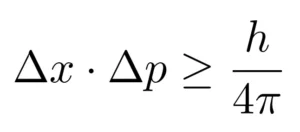
(Where h is Planck’s constant, a tiny number that governs scale of quantum world.)
Why does this happen? > To see an electron, you must bounce a photon (a particle of light) off it. However, because electrons are so small, the mere act of photon hitting electron changes electron’s speed and direction. By observing particle, you inevitably alter its state.
Key Implications
-
Determinism: Before Heisenberg, scientists believed in a clockwork universe where, if you knew position and velocity of every particle, you could predict future forever. Uncertainty Principle proved that we can’t even know present perfectly, making long-term absolute prediction impossible.
-
Wave-Particle Duality: This principle arises because particles like electrons behave like waves. A wave doesn’t have a single point of existence; it is spread out. Trying to pin down a wave’s exact location causes its wavelength (and thus its momentum) to become undefined.
-
Quantum Tunneling: Because a particle’s position is uncertain, there is a tiny mathematical chance it could exist on other side of an impenetrable barrier. This is why sun shines (nuclear fusion) and how your flash drive stores data.
Classical vs. Quantum
| Feature | Classical Physics (Newton) | Quantum Physics (Heisenberg) |
| Precision | Theoretically infinite. | Fundamentally limited. |
| Predictability | Deterministic (Effect follows Cause). | Probabilistic (Odds and Likelihoods). |
| Observation | Passive (Observer doesn’t change reality). | Active (Observation alters the system). |
Heisenberg famously said, “What we observe is not nature itself, but nature exposed to our method of questioning.” Uncertainty Principle reminds us that we aren’t just bystanders in universe; we are participants whose curiosity leaves a mark on world we try to measure.